


Tiny Space Arena: 1v1 battles
HC GLOBAL DISTRIBUTION LIMITED
My first impression of Tiny Space Arena: 1v1 battles was that it wants to make spaceship strategy feel approachable rather than overwhelming. It is a free strategy game from HC GLOBAL DISTRIBUTION LIMITED, built around the idea of creating a small starship and taking it into space combat. That sounds simple, but the appeal is in making choices with limited room: every part of a compact ship has to earn its place, and a design that looks impressive is not automatically a useful one.
I found it most enjoyable when I treated each match as a short experiment instead of expecting a large, story-heavy space adventure. The game is aimed at players who like building, adjusting and testing a plan, especially in a one-on-one setting. It is also suitable for Everyone, so the presentation is accessible to a broad audience. Still, the strategic decisions can be more interesting than the small scale suggests.
The game currently sits at a 4.7 average from around 14 thousand ratings, with more than 100 thousand installs. Those figures suggest that the compact format has found an audience, but they do not tell you whether it matches your preferred style. If you want a deep campaign, a large galaxy to explore or a traditional real-time strategy experience with many units on screen, this may feel deliberately limited. If you enjoy refining one machine and seeing whether your idea works against another player or opponent, it is easier to appreciate.
What to expect from the pocket-sized battles
The central experience is not about managing an enormous fleet. It is about the relationship between ship construction and the battle that follows. You shape a starship, enter a small arena and discover whether your choices hold up under pressure. That makes the game feel closer to a focused design puzzle than to a conventional space simulator.
For a first-time player, the important expectation is that success will probably come from adjustment rather than from a single perfect build. A ship that seems powerful in one encounter may expose a weakness in another. I recommend paying attention to what actually causes a loss instead of immediately rebuilding everything. If the problem is poor protection, changing the entire design can hide the useful lesson. Small, deliberate changes make the strategy easier to understand.
Related News






The one-on-one format is a strength because it keeps the action readable. You can concentrate on the opposing ship and your own construction rather than searching through a crowded battlefield. It also creates a clear trade-off: there is less chaos, but fewer distractions from the quality of your decisions. Players who enjoy direct comparisons will likely find that satisfying. Players who prefer large-scale battles may find the arena too restrained.
I would describe the game as a light strategy title with a construction focus, not as a full replacement for a complex desktop-style space strategy game. The compact presentation makes it suitable for short sessions, yet the design choices can still encourage repeated attempts. That combination works particularly well on a phone, where I may only have a few minutes but still want something more thoughtful than a purely reflex-based game.
Getting through the first setup without overthinking it
When starting, I would resist the temptation to create the most elaborate ship possible. A first build should be easy to understand. Use the initial setup to learn what each available choice changes, then keep the design simple enough that you can connect the result to the battle. If you make several major changes at once, a victory or defeat will not teach you much about which decision mattered.
Gallery
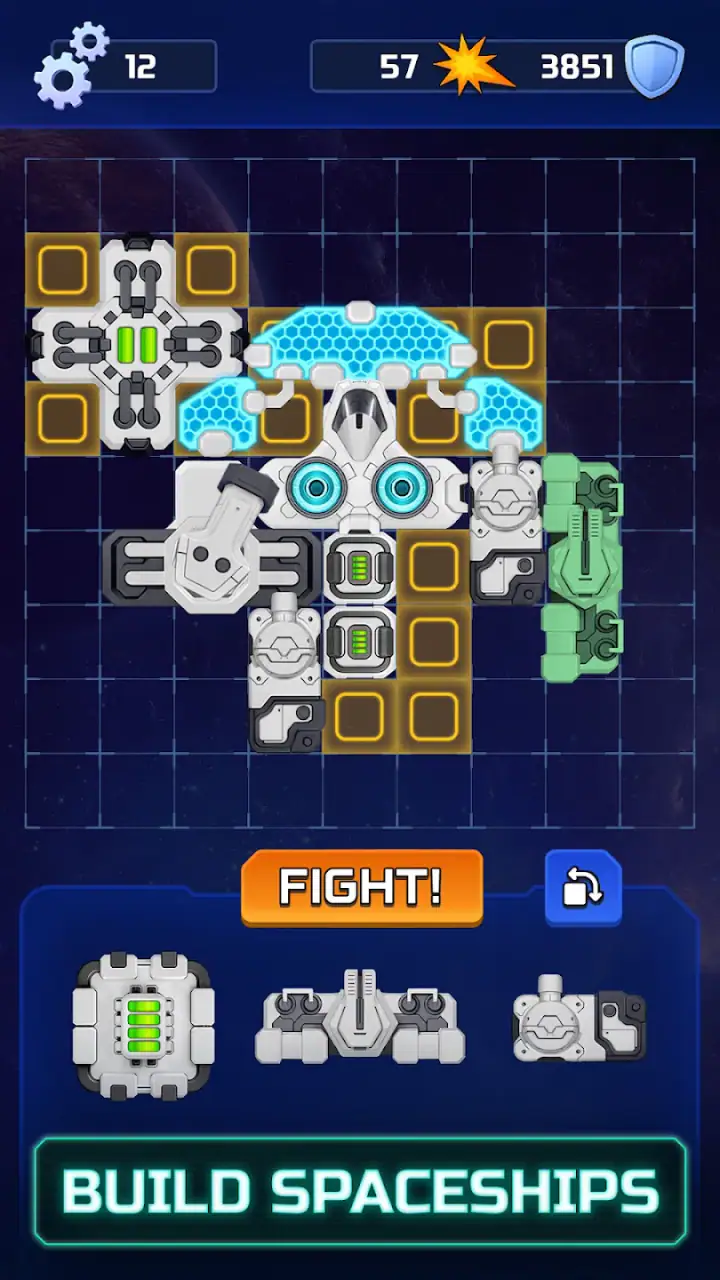
A useful beginner workflow is to choose a basic design, enter a battle, observe the result, and then alter one area at a time. This is more effective than rebuilding after every uncomfortable moment. In a small arena, a minor weakness can become obvious quickly, so the game gives you a practical feedback loop: build, test, inspect the outcome and try again.
I also suggest taking a moment to look at the whole ship rather than focusing on the most visually attractive part. A strong-looking component is not automatically the best choice if it leaves the rest of the design unbalanced. The real skill is learning to think in terms of the ship as a system. That is one of the less obvious pleasures of the game, and it is easy to miss if you rush straight into repeated battles without reflecting on the result.
The current version is 1.0.5, and the game requires Android 8.0 or later. That makes checking your device compatibility a sensible first step before investing time in a build. The game is free to install, while optional in-app purchases range from $0.29 to $99.99 per item. I would approach those purchases carefully: the most valuable early investment is understanding the construction choices, not assuming that spending will replace experimentation.
The first meaningful success is a repeatable build
For me, the first meaningful success was not simply winning one encounter. It was producing a ship that behaved in a way I expected. That distinction matters. A lucky victory can be entertaining, but a repeatable result shows that you are beginning to understand the relationship between design and combat.
To reach that point, start with a clear intention. Decide whether you are trying to make a balanced ship, emphasize protection or create a more aggressive arrangement. Then watch what happens when the battle begins. Does the ship survive long enough to use its strengths? Does the design fail before its main idea has a chance to work? These questions turn a quick match into useful information.
One practical tip is to judge a build by its weakness, not only by its best moment. If a ship performs well when everything goes right but collapses immediately after one problem, it may be less reliable than a modest design that recovers from pressure. In a one-on-one arena, consistency can matter more than a spectacular first impression.
Another helpful habit is to keep mental notes about changes. You do not need a formal spreadsheet, but remember what you altered before each battle. This prevents the common beginner mistake of changing the design so many times that the results become impossible to interpret. The compact scale makes this kind of disciplined testing practical, and it gives the game more depth than its tiny presentation might suggest.
There is also a useful everyday scenario here. Imagine having a short break between tasks and wanting a game that can be played without committing to a long campaign. You can make one adjustment, try a battle and put the phone away with a clear next experiment in mind. Later, you can return to that idea instead of having to remember a sprawling storyline or a large collection of units. That makes the game a good fit for brief, focused sessions.
Where new players may become confused
The biggest source of confusion is likely to be the difference between building something that looks strong and building something that performs well. A compact starship can appear impressive while still having a practical weakness. I found it better to treat the visual arrangement as a starting point, then let the battle reveal whether the design makes sense.
Another possible stumbling block is expecting every defeat to mean that the entire ship is wrong. In a strategy game, a loss can point to one poor choice, an awkward balance or a mismatch between your intended approach and the actual encounter. Rebuilding from scratch every time may feel productive, but it often throws away information. Change the part most closely connected to the problem first.
New players may also wonder whether they should spend money immediately. My advice is no. The free entry point gives you a chance to decide whether the construction loop suits you before considering any purchase. Because the available purchase range extends from small optional items to much more expensive ones, setting a personal limit is sensible. The game is easier to evaluate when your opinion is based on the play itself rather than on pressure to buy something.
The one-on-one structure can create another misunderstanding. A small arena does not necessarily mean that every match is simple, but it does mean that the game is focused. There are fewer moving parts to blame when a plan fails. That is good for learning, although it can feel unforgiving if you prefer games where a large battlefield lets you recover from one mistake.
I would also avoid comparing it directly with a traditional base-building strategy game. Those alternatives usually ask you to manage resources, expand over time and handle several systems at once. Tiny Space Arena: 1v1 battles concentrates attention on the ship and the immediate contest. That makes it faster to understand, but it also means you should not expect the same long-term empire-building satisfaction.
How it compares with other strategy choices
Compared with large space strategy games, this one is much easier to approach. You are not asked to learn a huge technology tree or oversee a sprawling map before seeing the result of a decision. The advantage is clarity: your design is close to the action. The disadvantage is that players looking for exploration, diplomacy or a long campaign may quickly feel that the scope is too narrow.
Compared with action-oriented space games, it gives your decisions more weight. Reflexes may still matter to the overall experience, but the defining appeal is the ship you bring into the arena. If you enjoy watching a plan succeed because you prepared it well, this is more rewarding than a game where victory depends mainly on rapid tapping.
It also differs from collectible or upgrade-heavy strategy games in an important way: the most satisfying progress comes from understanding your construction choices. That does not mean every player will experience the same progression, and it does not remove the appeal of optional purchases. It does mean that a thoughtful player can get value from testing ideas rather than simply chasing the next item.
For children and families, the Everyone rating makes the game easier to consider from a content standpoint. However, age suitability does not automatically mean every child will enjoy the strategic learning curve. A younger player who wants instant action may lose interest, while someone who likes assembling and testing machines may find the compact format inviting. I would play alongside a child at first, both to explain the choices and to establish sensible boundaries around optional spending.
Who should install it, and who should skip it
I would recommend it to players who like small strategy problems, spaceship construction and direct one-on-one tests. It is especially suitable if you enjoy asking, “What changed when I rebuilt this part?” rather than needing a large story or a constant stream of new locations. It also fits people who want a strategy game that can be sampled in short sessions.
I would be more cautious if you want a rich narrative, a persistent galaxy or the feeling of commanding an entire civilization. The game’s appeal comes from focus, and that same focus limits its variety compared with broader strategy alternatives. It may also disappoint players who dislike repeating an encounter while refining a design. The testing process is part of the experience, not an obstacle that disappears after the first attempt.
Players who are uncomfortable with in-app purchases should pay attention before using the game regularly. Since the title is free but includes optional items across a wide price range, I would use device-level purchase controls if the phone is shared with children. That is not a criticism of the construction concept; it is simply a practical step that keeps the free-to-start model predictable.
Finally, check the operating-system requirement before downloading. Android users need version 8.0 or later. If the device meets that requirement and you enjoy compact strategic experimentation, the free installation makes trying it fairly low-risk.
The best way to continue after the first win
After achieving a reliable result, I would not immediately chase the most complicated design. Instead, test whether your successful build has a clear weakness. Try a modest variation and compare how it behaves. This creates a personal understanding of the game rather than a dependence on copying one arrangement.
A second useful step is to define what you want from the next battle. You might focus on surviving longer, making the ship more balanced or seeing whether a more aggressive idea works. A specific goal makes each attempt meaningful. Without one, it is easy to make random changes and mistake movement for progress.
I also recommend keeping the game in its proper place among your other mobile games. It is not trying to replace every kind of strategy experience. Think of it as a pocket-sized workshop where you design a ship and put the idea under pressure. That description helped me enjoy it more because I stopped judging it by the standards of massive strategy titles.
HC GLOBAL DISTRIBUTION LIMITED has made a game that is easy to enter but offers more thought than its small presentation initially suggests. The 4.7 average and broad install base show that the concept has attracted attention, while the free price lets curious players test the core appeal without an upfront commitment. My recommendation is straightforward: install it if you like building, comparing and refining compact strategies. Skip it if you need a campaign, a huge battlefield or constant variety.
My final advice to a new player is to aim for understanding rather than an immediate perfect win. Build something simple, observe the result, change one meaningful element and try again. Once the ship begins behaving the way you intended, the small arena becomes much more engaging. The real reward is not merely conquering one battle; it is learning why your starship succeeded.
FAQs for Tiny Space Arena: 1v1 battles
What is Tiny Space Arena: 1v1 battles?
Tiny Space Arena: 1v1 battles is a competitive mobile game focused on short, head-to-head space combat matches. Players control a small spacecraft, maneuver around compact arenas, and try to outplay an opponent using movement, timing, attacks, and tactical positioning. Its bite-sized format makes it suitable for quick sessions, while the direct one-versus-one structure keeps every decision important from the opening move to the final hit.
How do matches work in Tiny Space Arena: 1v1 battles?
Matches are built around direct duels between two players or opposing spacecraft. You generally need to move carefully, avoid incoming attacks, line up your own shots, and use the arena layout to create an advantage. Because the battles are compact, success depends less on long preparation and more on fast reactions, understanding attack patterns, and learning when to take risks or play defensively.
Is Tiny Space Arena: 1v1 battles suitable for beginners?
The game can be approachable for beginners because its central idea is easy to understand: defeat the opposing player in a space arena. However, becoming consistently successful may take practice. New players should expect to spend time learning movement, attack timing, defensive positioning, and the behavior of different abilities or weapons. Early losses are useful for discovering how opponents create pressure and how to respond more effectively.
Does Tiny Space Arena: 1v1 battles require an internet connection?
Because Tiny Space Arena: 1v1 battles is designed around competitive one-versus-one encounters, an internet connection may be necessary for online matchmaking and other connected features. Availability of offline play, training options, or practice modes can depend on the version installed and the developer’s current implementation. Before downloading, players who expect to play while traveling should check the store listing and in-game requirements.
Is Tiny Space Arena: 1v1 battles free to download and does it include purchases?
The game may be available as a free download, but players should review the official Google Play or App Store listing for the current pricing and monetization details. Free mobile games can include advertising, optional purchases, cosmetic upgrades, progression items, or other paid features. Checking these details before installation is especially important for parents and for users who prefer a completely ad-free or purchase-free experience.
Pros
- Quick 1v1 matches are ideal for short gaming sessions.
- Simple controls make the game easy to pick up.
- Competitive battles offer satisfying skill-based gameplay.
- Small arenas keep matches focused and action-packed.
- The space theme gives the game a distinctive visual style.
Cons
- Matchmaking may feel uneven against more experienced players.
- Limited arena variety can make battles feel repetitive.
- Progression may become grindy after extended play.
- Online play depends on a stable internet connection.
- Some players may find the fast pace difficult to follow.


